

Comparing Medicare Advantage plans in Michigan is not just about the lowest premium. Your doctor, physician specialists, medications, hospitals, county, zip code, and budget all matter.
For 2026, there are 192 Medicare Advantage plans available in Michigan, and the average monthly premium is $16.56. All Michigan residents with Medicare have access to at least one $0-premium Medicare Advantage plan. Plan availability can vary depending on where you live, with Oakland County showing 103 Medicare Advantage plans available and Wayne County showing 90. (Healthline)
Sunnyside Medicare helps Michigan residents compare Medicare plans in plain English. The goal is simple: review your options, check the details, and choose coverage that fits your situation.
2026 Michigan Medicare Advantage
| 2026 Michigan Medicare Advantage | Detail |
|---|---|
| Available Medicare Advantage plans | 192 plans available in Michigan for 2026 |
| Average monthly premium | $16.56 |
| $0 premium access | All Michigan residents with Medicare have access to at least one $0-premium Medicare Advantage plan |
| What still matters | Doctor network, prescriptions, hospitals, pharmacy, county, zip code, and out-of-pocket costs |
What Are Medicare Advantage Plans?
For the official federal overview, Medicare.gov’s Understanding Medicare Advantage Plans guide is a useful resource while comparing plan types.
Medicare Advantage plans, also called Part C, are Medicare plans offered by Medicare approved private companies. They are another way to receive Medicare coverage instead of using Original Medicare by itself.
Medicare Advantage plans must cover almost all medically necessary services Original Medicare covers. Some plans may also offer extra benefits that Original Medicare does not cover, such as dental, vision, hearing, and other additional services. (Medicare)
Medicare Part C Explained
Medicare Part C combines Medicare Part A hospital insurance and Medicare Part B medical coverage into one health plan. Most Medicare Advantage plans also include Part D prescription drug coverage, so one health plan may include hospital care, medical coverage, and a prescription drug plan.
Medicare health plans provide Part A hospital insurance and Part B medical insurance benefits to people with Medicare, and Medicare Advantage plans are one type of Medicare health plan. (Medicare)
Medicare Advantage vs. Original Medicare
| Factor | Medicare Advantage | Original Medicare |
|---|---|---|
| How coverage works | You get Medicare coverage through a private health plan approved by Medicare | You get Medicare coverage directly through the federal Medicare program |
| Hospital insurance | Includes Medicare Part A hospital insurance | Includes Medicare Part A hospital insurance |
| Medical coverage | Includes Medicare Part B medical coverage | Includes Medicare Part B medical coverage |
| Prescription drug coverage | Most Medicare Advantage plans include Part D prescription drug coverage | Usually requires a separate prescription drug plan |
| Provider access | Usually network-based, depending on the plan | Broad access to doctors and hospitals that accept Medicare |
| Referrals / approvals | Some plans may require referrals or prior authorization | Original Medicare generally has fewer plan-based network rules |
| Extra benefits | May include dental, vision, hearing, transportation, fitness, or wellness benefits | Usually does not include most routine dental, vision, or hearing benefits |
| Out of pocket protection | Medicare Advantage plans have an annual out-of-pocket maximum for covered services | Original Medicare does not have the same built-in annual out-of-pocket cap |
Original Medicare covers most medically necessary services in hospitals, doctors’ offices, and other healthcare facilities. Medicare Advantage plans must cover medically necessary services Original Medicare covers, but they may also offer extra benefits Original Medicare does not. (Medicare)
Medicare Coverage: What Is Included?
Every Medicare Advantage plan must include core Medicare coverage provided under Original Medicare. Medicare Part A covers inpatient hospital stays, skilled nursing facility care, hospice care, and some home health care. Medicare Part B covers doctor visits, outpatient care, preventive care, and other medical services.
Most Medicare Advantage plans also cover additional services such as dental, vision, hearing, transportation, wellness programs, fitness memberships, and over-the-counter Flex or Rewards cards.
Additional Benefits Beyond Original Medicare
Most plans include benefits that go beyond standard coverage. Depending on the plan, benefits may include:
- Dental
- Vision
- Hearing
- Prescription drug coverage
- Wellness programs
- Fitness memberships
- Transportation to medical appointments
- Flex cards or rewards cards for over-the-counter items and healthy living rewards
These benefits can help, but coverage limits, provider rules, premiums, deductibles, copays, and coinsurance vary depending on the specific health plan.
Why Zip Code and County Matter
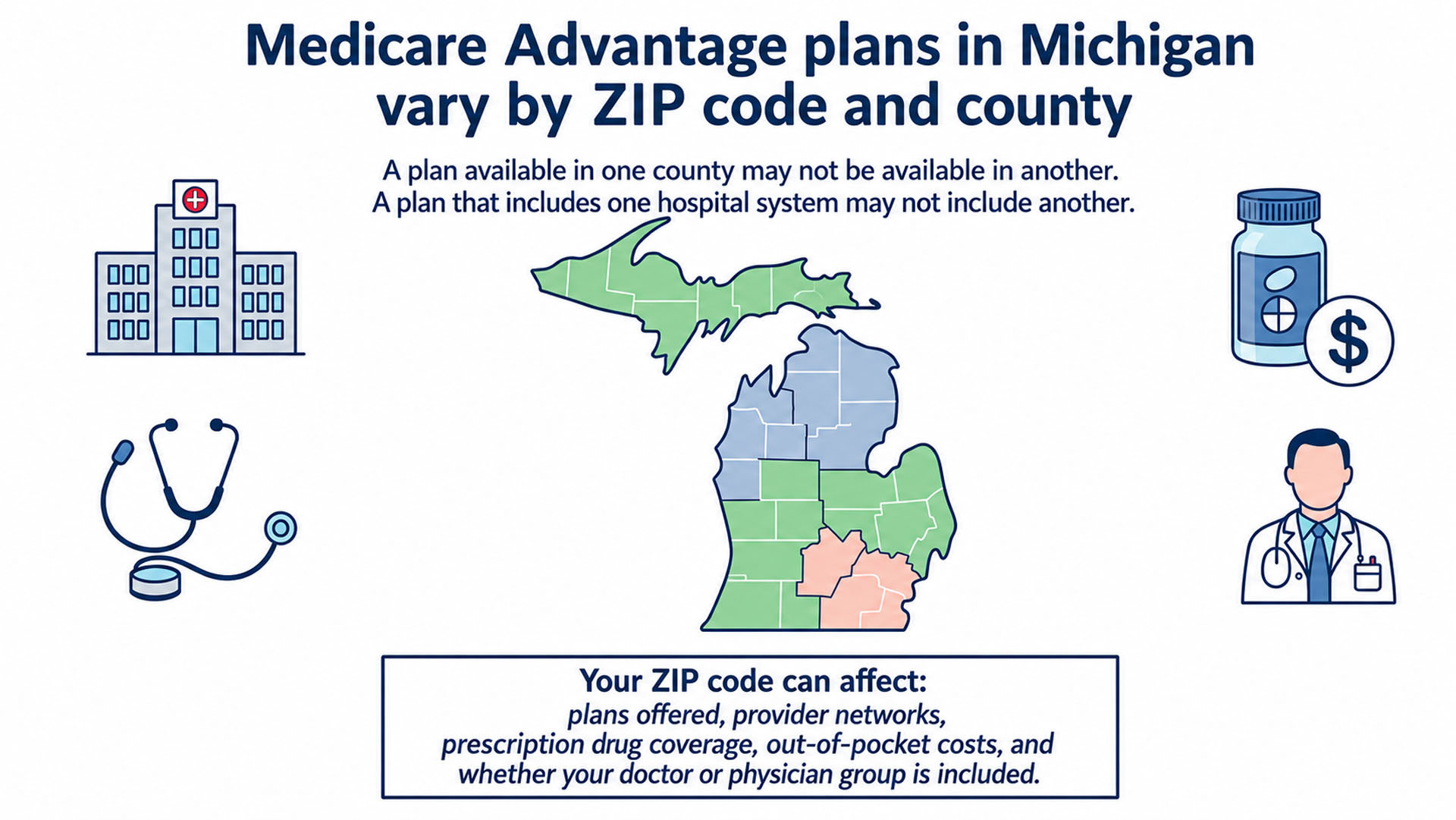
Medicare Advantage plans in Michigan vary by zip code and county. A plan available in one county may not be available in another. A plan that includes one hospital system may not include another.
That is why Michigan Medicare Advantage plans need a local review. Your zip code can affect the plans offered, provider networks, prescription drug coverage, out-of-pocket costs, and whether your doctor or physician group is included.
2026 Costs, Premium Plans, and Ways to Save Money
A $0 premium does not mean the plan is free. You may still pay your Medicare Part B premium, deductibles, copays, coinsurance, medication costs, and other out-of-pocket costs.
Some premium plans may still be worth reviewing if they offer stronger provider access, better prescription drug coverage, or lower total costs. The goal is not just the cheapest plan. The goal is to find a plan that may help you save money over the full year.
$0 premium does not mean $0 cost.
You may still pay your Medicare Part B premium, deductibles, copays, coinsurance, prescription costs, and other out-of-pocket costs. Some premium plans may still save money over the year if they better fit your doctors, prescriptions, and healthcare needs.
How CMS Star Ratings Work
The Centers for Medicare & Medicaid Services rates Medicare Advantage and Part D plans every year using a five-star system. Five stars is the highest rating, and one star is the lowest.
CMS ratings are based on quality and performance measures. Star ratings can help beneficiaries compare Medicare Advantage companies, but they should not be treated as a personal fit score.
For 2026, Medicare Advantage Prescription Drug contracts are rated on up to 43 quality and performance measures, while MA-only contracts without Part D coverage are rated on up to 33 measures. (Centers for Medicare & Medicaid Services)
What 2026 Star Ratings Show
For 2026, CMS reported that 18 Medicare Advantage Prescription Drug contracts earned 5 stars, 73 earned 4.5 stars, and 116 earned 4 stars. About 40% of MA-PD contracts earned 4 stars or higher, and about 64% of MA-PD beneficiaries are in contracts rated 4 stars or higher. (Centers for Medicare & Medicaid Services)
That makes star ratings useful. But a high rating does not automatically mean a health plan is right for your doctors, hospitals, medications, pharmacy, or budget.
Examples of 2026 Medicare Advantage Star Ratings in Michigan
These examples are not a ranking of the best Medicare Advantage plans in Michigan. They are examples of 2026 star ratings for plans in Michigan that may appear during a zip code search.
| Carrier / Plan Example | Plan Type | 2026 CMS Star Rating | What to Review Before Choosing |
|---|---|---|---|
| Medicare Plus Blue Signature / Blue Cross Blue Shield of Michigan | PPO | 4.5 | Review doctor access, hospital access, prescription drug coverage, pharmacy costs, and PPO out-of-network rules. (Medicare.org) |
| BCN Advantage Classic / Blue Care Network | HMO POS | 4.5 | Review HMO POS rules, referrals, provider centers, prescriptions, and whether your doctors and hospitals are in network. (Medicare.org) |
| PriorityMedicare Key / Priority Health Medicare | HMO POS | 4.5 | Review county availability, network access, prescriptions, and total yearly costs before choosing. (q1medicare.com) |
| Trinity Health Plan of Michigan HMO plans | HMO | 4.0 | May be relevant for people already using Trinity Health doctors or hospitals, but network fit still matters. (Trinity Health Plan) |
| Trinity Health Plan of Michigan Glory No RX | HMO | 4.0 | Example of a Trinity Health Plan option without Part D prescription drug coverage. (Medicare.org) |
| HAP Medicare Advantage PPO and HMO plans | PPO / HMO | 4.0 | Review whether HAP’s network fits your doctors, hospitals, prescriptions, and county. (HAP) |
A higher-rated plan is not always the better plan for you.
CMS Star Ratings can help you compare Medicare Advantage companies, but they do not check your personal doctors, prescriptions, pharmacy, hospitals, county, or budget. A 4-star plan that fits your life may be better than a 5-star plan that does not.
Ratings Are Not a Personal Fit Score
A 5-star plan may not include your doctor. A 4.5-star plan may have higher medication costs. A 4-star plan may fit your hospital, pharmacy, and budget better than a higher-rated plan.
The best plan is the one that fits your actual life.
Blue Cross Blue Shield of Michigan Medicare Advantage
Blue Cross Blue Shield of Michigan is one of the carrier names people recognize. You may also see Blue Cross, Blue Shield of Michigan, Medicare Plus Blue, Blue Care Network, and BCN Advantage in searches.
Some people search cross blue shield, blue cross, blue shield of michigan, or cross blue shield of michigan when looking for Blue Cross Blue Shield of Michigan information. The name matters less than the plan details.
Blue Cross Blue Shield does sell Medicare Advantage plans, but a familiar name does not automatically mean the plan is the right fit. Check network access, hospital access, coverage, premiums, deductibles, coinsurance, and out-of-pocket costs.
BCN Advantage and HMO POS Plans
Blue Care Network is connected to Blue Cross Blue Shield. BCN Advantage plans are advantage plans offered through Blue Care Network.
Many BCN Advantage plans use an HMO POS structure. You may see plan options such as BCN Advantage Classic, BCN Advantage Elements, or BCN Advantage ConnectedCare. Before choosing one, review referral rules, out-of-network limits, provider centers, medications, and hospitals.
Trinity Health Plan and Other Options
Trinity Health Plan is another health plan name people may see when comparing advantage plans. Trinity Health Plan may be especially relevant for people who already use Trinity Health hospitals, doctors, or healthcare services.
Still, do not choose by name alone. Review the network, benefits, prescription drug plan details, costs, and star ratings first.
Types of Medicare Advantage Plans
There are several types of Medicare Advantage plans. These include Health Maintenance Organizations, Preferred Provider Organizations, Special Needs Plans, Medicare Medical Savings Accounts, and Private Fee-for-Service Plans.
Most plans have different rules for doctors, hospitals, referrals, costs, and out-of-network care.
Plan Type Comparison
| Plan Type | How It Usually Works | May Be a Good Fit If | Watch Outs |
|---|---|---|---|
| HMO | Usually requires in-network doctors and hospitals except for emergencies or urgent care | You want lower costs and already like the plan’s network | Less flexibility if your doctor, hospital, or physician specialist is outside the network |
| HMO POS | Works like an HMO, but may allow certain out-of-network services under specific rules | You want an HMO-style plan with a little more flexibility | Out-of-network rules can be limited and vary depending on the health plan |
| PPO | Usually gives more flexibility to see out-of-network providers | You travel, split time between areas, or want broader provider access | You may pay more for out-of-network care |
| SNP | Designed for people with specific needs, such as dual eligibility, chronic conditions, or institutional care | You have both Medicare and Medicaid, or you qualify based on a specific health situation | Eligibility rules, benefits, and provider networks need careful review |
| PFFS / MSA | Less common Medicare Advantage plan types with different payment or savings-account structures | You want a less traditional plan structure and understand the tradeoffs | Availability may be limited, and rules can be less familiar |
Medicaid Services and Dual Eligible Plans
If you have both Medicare and Medicaid, you may qualify for a dual eligible plan. These plans can help coordinate coverage, Medicaid services, medication costs, and extra benefits.
Dual eligible plans need careful review because benefits, provider access, and costs can vary by county and eligibility.
Prescription Drug Coverage and Part D
Most Medicare Advantage plans include prescription drug coverage through Part D. This can make coverage simpler because medical services and medications are handled through one health plan.
Medicare Part D helps pay for brand-name and generic medications. It is optional and offered to everyone with Medicare by insurance companies and other private companies approved by Medicare. (Medicare)
Check the Formulary Before You Enroll
Before you enroll, check the plan’s formulary. A formulary is the list of medications the plan covers.
Look at whether your medications are covered, the tier, whether there is a prescription deductible, whether prior authorization is required, preferred pharmacies, and what the prescription may cost for the full year.
Medicare drug plans may use prior authorization, step therapy, quantity limits, and preferred pharmacy networks, so prescription drug coverage should be checked against your actual medication list. (Medicare)

Are Metformin and Montelukast Covered?
Metformin and montelukast may be covered by many Medicare drug plans, but the safe answer is to check the specific prescription drug plan or Medicare Advantage formulary before you enroll.
The cost can vary depending on the drug tier, deductible, pharmacy, and whether the plan uses prior authorization or step therapy.
How to Compare Medicare Advantage Plans in Michigan
When comparing Medicare Advantage plans in Michigan, do not look at the premium alone.
| What to Check | Why It Matters |
|---|---|
| Doctor network | A plan can look good online and still be wrong if your doctor is not in network |
| Physician specialists | Cardiologists, neurologists, endocrinologists, and other specialists can make or break plan fit |
| Hospital access | Your preferred hospital system may not be included in every plan |
| Prescription drug coverage | Formularies, tiers, deductibles, and prior authorization rules can change your costs |
| Pharmacy network | Preferred pharmacies may offer lower prescription costs |
| County and zip code | Plans offered can vary depending on where you live |
| Premiums | $0 premium plans can be useful, but they are not always the lowest-cost choice overall |
| Deductibles | Medical and prescription deductibles affect what you pay before coverage kicks in |
| Copays and coinsurance | These determine what you pay when you actually use care |
| Maximum out-of-pocket limit | This is your annual protection limit for covered services in the plan |
| Dental, vision, and hearing | Extra benefits are helpful, but coverage depth varies by plan |
| Transportation and wellness benefits | Some plans include transportation, fitness, wellness, or over-the-counter rewards |
| Star ratings | Ratings are useful, but they should not override doctor, hospital, prescription, and budget fit |
What Is the Best Medicare Advantage Plan?
The best Medicare Advantage plan depends on your situation. There is no single best plan for every person.
For one person, the best Medicare Advantage plans may be PPO options with broader hospital access. For another person, the best plan may be an HMO POS option with lower costs and the right doctor network.
The best Medicare Advantage plans are not always the highest-rated plans. They are the plans that fit your doctors, hospitals, prescriptions, pharmacy, budget, and county.
What Is the Downside of Medicare Advantage?
The biggest downside is that most plans have network and coverage rules. You may need to stay in network, get referrals, use certain hospitals, follow prior authorization rules, or pay more for out-of-network care.
This does not mean Medicare Advantage is bad. It means the plan needs to be checked before you choose it.
Does Heart Failure Qualify for Medicare?
Heart failure by itself does not automatically qualify someone for Medicare. Eligibility is usually based on age, disability status, End-Stage Renal Disease, ALS, or other qualifying rules.
Once someone is eligible, Medicare may cover services related to heart failure depending on the care, provider, and plan.
Is Parkinson’s Covered by Medicare?
Medicare may help cover care related to Parkinson’s once a person is eligible. Coverage can include doctor visits, medications, therapy, testing, and other healthcare services depending on the plan.
People with chronic conditions should compare more than premiums. Specialist access, hospitals, medications, and prior authorization rules matter.
When Can You Enroll?
To enroll in Medicare Advantage, you generally need Medicare Part A and Medicare Part B first. Your Initial Enrollment Period lasts seven months, starting three months before you turn 65 and ending three months after the month you turn 65. (Medicare)
Enrollment Timeline
| Enrollment Window | When It Happens | What You Can Usually Do |
|---|---|---|
| Initial Enrollment Period | 3 months before your 65th birthday month, your birthday month, and 3 months after | Enroll in Medicare Part A and Part B, then choose Medicare Advantage if it fits |
| Fall Open Enrollment | October 15 through December 7 each year | Review, tailor, or change Medicare Advantage and Part D coverage for the next year |
| Medicare Advantage Open Enrollment | January 1 through March 31 | If you already have Medicare Advantage, you may be able to switch plans or return to Original Medicare |
| Special Enrollment Period | Triggered by certain life changes | May apply if you move, lose employer coverage, qualify for Medicaid, or your plan changes/ends |
Medicare.gov states that the Medicare Advantage Open Enrollment Period runs from January 1 through March 31 for people already in a Medicare Advantage plan. During that period, they can switch to another Medicare Advantage plan or return to Original Medicare and join a separate Medicare drug plan. (Medicare)
What if Your Employer Coverage Is Ending?
If you are retiring or losing employer coverage, you may qualify for a Special Enrollment Period. Employer timing matters because a late move can create gaps or penalties.
A local agent can help compare Medicare Advantage, Medicare Supplement, and Part D plan options before employer coverage ends.
Is Blue Cross Dropping Medicare Advantage?
Plan availability can change by year, county, contract, and zip code. Instead of relying on rumors, review current plan options where you live.
If your plan sends an Annual Notice of Change, read it carefully before open enrollment.
Are Blue Cross Blue Shield Medicare Advantage Plans Good?
Blue Cross Blue Shield Medicare Advantage plans may be a good fit for some Michigan residents. They may not be the right fit for others.
The better question is not only, “Is Blue Cross good?” The better question is, “Does this Blue Cross Blue Shield of Michigan or Blue Care Network plan fit my doctors, prescriptions, hospitals, county, and costs?”
What Is the Highest Rated Medicare Advantage Plan in Michigan?
The highest rated Medicare Advantage plan in Michigan can vary by year, county, zip code, and eligibility.
Some 5-star plans may be available in limited areas or to limited groups. That does not mean a 5-star plan is available to every Michigan resident. And even when a high-rated plan is available, it still needs to fit your doctors, prescriptions, hospitals, pharmacy, and budget.
Which Insurance Companies Are Dropping Medicare Advantage Plans in 2026?
Insurance companies can change Medicare Advantage plans by year, market, and county. Some national carriers have reduced plan options in certain areas, but the practical step is the same: check your Annual Notice of Change and review plans in your zip code before open enrollment ends. (Healthcare Finance News)
Do not assume a national headline applies to your county, your plan, or your doctors.
Medicare Resources and Local Help
Medicare resources include Medicare.gov, 1-800-MEDICARE, and the Michigan Medicare Assistance Program. Residents can receive free local help from MMAP.
Online resources are helpful, but they do not replace a local plan review when doctors, hospitals, medications, and budget are involved.
How Sunnyside Medicare Helps
Sunnyside Medicare is a Michigan-based independent Medicare brokerage. The team helps compare Medicare Advantage, Medicare Supplement, and Part D prescription drug plans from multiple carriers.
They are not limited to one insurance company. They compare the market, explain the tradeoffs, and help review doctors, medications, hospitals, benefits, and budget.
The process is simple:
- Review your doctors.
- Check your prescriptions.
- Compare plan options in your zip code.
- Review costs, benefits, and networks.
- Choose coverage that fits your health, budget, and comfort level.

Get Help Comparing Medicare Advantage Plans in Michigan
If you are comparing Medicare Advantage plans in Michigan for 2026, start with the facts. Review star ratings. Check prescription drug coverage. Confirm doctors and hospitals. Compare premiums, deductibles, coinsurance, and out-of-pocket costs.
Then talk to a licensed agent who can connect those details to your situation. Sunnyside Medicare helps compare Medicare plans clearly, calmly, and without pressure.