

Medicare Annual Enrollment Period is here again, and one of the biggest questions for Michigan residents is simple: what is changing this year?
The 2026 Medicare Annual Enrollment Period runs from October 15 through December 7, 2026. Changes made during this period generally take effect January 1, 2027.
For 2027, several Medicare changes deserve attention. Medicare Part D costs are changing. Negotiated prices take effect for another group of high-cost prescription drugs. A temporary Part D premium stabilization program is ending. Medicare Advantage plans can change their costs, benefits, provider networks, and prescription coverage. Michigan is also preparing to expand MI Coordinated Health for people who qualify for both Medicare and Medicaid.
Your own plan may change too. Premiums, provider networks, prescription drug formularies, pharmacy networks, copays, deductibles, and supplemental benefits can all look different from one year to the next.
This Medicare AEP guide for 2026 in Michigan focuses on the practical questions: What changed? How could it affect you? And what should you do before deciding whether to keep or change your Medicare coverage for 2027?
2027 Medicare Changes in Michigan at a Glance
| 2027 Medicare Change | What It Could Mean for You | Details |
|---|---|---|
| Part D standard deductible increases | The maximum standard deductible increases from $615 in 2026 to $700 in 2027. | Jump to section |
| Part D out-of-pocket threshold increases | The annual threshold increases from $2,100 in 2026 to $2,400 in 2027. | Jump to section |
| 15 more negotiated drug prices take effect | Medicare-negotiated prices take effect for another group of high-cost Part D drugs. | Jump to section |
| Part D Premium Stabilization Demonstration ends | Stand-alone Part D premiums may change, making annual plan comparison especially important. | Jump to section |
| Medicare Advantage plans change for 2027 | Premiums, copays, maximum out-of-pocket costs, provider networks, and extra benefits may change. | Jump to section |
| Drug formularies and pharmacy networks can change | Your prescriptions, drug tiers, or preferred pharmacy pricing may be different. | Jump to section |
| MI Coordinated Health expansion is planned | Michigan is preparing to expand its integrated Medicare and Medicaid program statewide in 2027. | Jump to section |
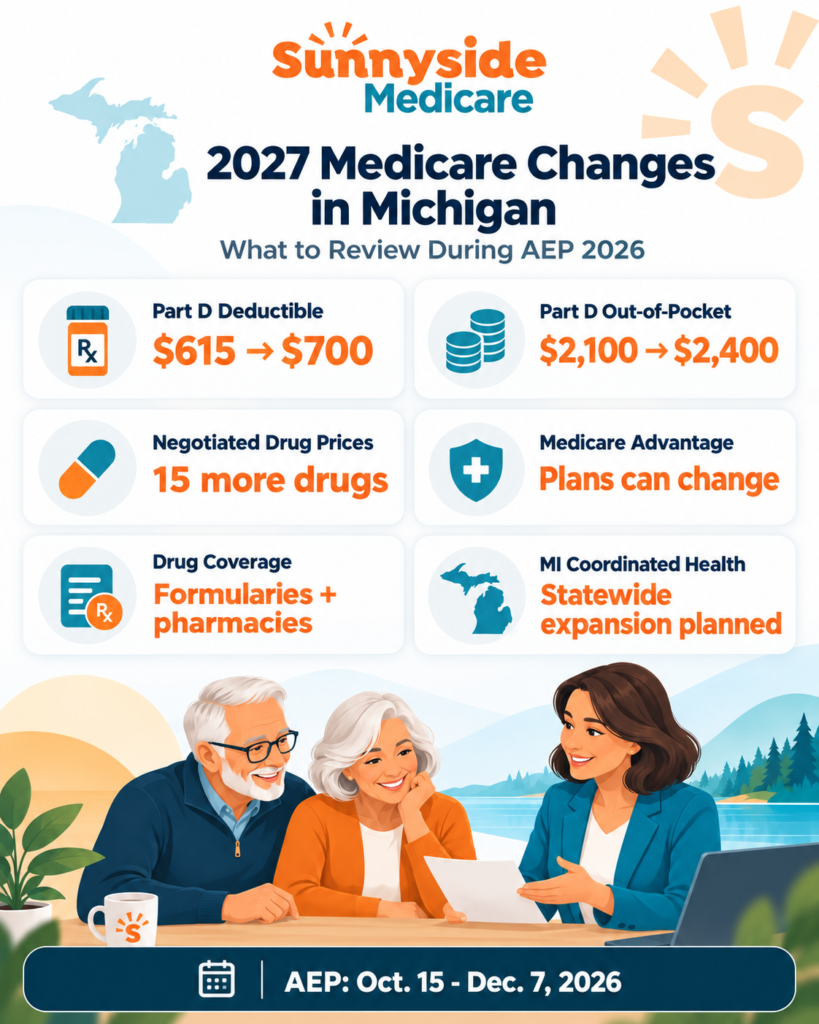
The most important thing to remember is that not every change affects every Medicare beneficiary the same way. A prescription drug change may matter enormously to one person and hardly at all to another. A provider network change may matter more than any premium change if keeping a specific doctor or hospital is your highest priority.
Medicare AEP 2026 Dates
The Medicare Annual Enrollment Period, commonly called AEP or Medicare Open Enrollment, runs from October 15 through December 7 each year.
- October 15, 2026: AEP begins.
- December 7, 2026: AEP ends.
- January 1, 2027: Most coverage changes made during AEP take effect.
AEP is primarily for people who already have Medicare and want to review or change certain Medicare Advantage or prescription drug coverage choices. It is different from your Initial Enrollment Period, which is generally when you first become eligible for Medicare. Medicare also has a General Enrollment Period, Special Enrollment Periods, and a separate Medicare Advantage Open Enrollment Period.
This article is intentionally focused on what is changing for Michigan beneficiaries during the 2026 AEP. For a complete explanation of the different enrollment periods, when they apply, and what changes are allowed during each one, see our Medicare Enrollment Periods Guide.
What Is Changing With Medicare for 2027?
Some Medicare changes happen nationally. Other changes depend entirely on your current Medicare Advantage plan, Medicare Part D plan, Michigan county, doctors, prescriptions, and pharmacy.
That distinction matters. A national change may affect millions of Medicare beneficiaries, while a relatively small provider-network change could matter far more to you personally because it affects the specialist or hospital you actually use.
Medicare Part D Deductible Increases in 2027
What Is Changing?
For the Medicare Part D defined standard benefit, the maximum standard deductible increases from $615 in 2026 to $700 in 2027. The Centers for Medicare & Medicaid Services also increased the Part D annual out-of-pocket threshold from $2,100 to $2,400 for 2027.
Not every Medicare Part D plan uses the full maximum deductible. Some prescription drug plans may have a lower annual deductible or apply the deductible differently to certain drug tiers.
How Could This Affect You?
If your Part D plan uses the full deductible, you could pay more before the plan begins paying its share for certain covered medications. The actual impact depends heavily on the prescription medications you use.
Someone taking expensive brand-name or specialty medications may experience the deductible very differently from someone whose prescriptions consist mostly of lower-cost generic drugs.
What Should You Do?
Do not compare Part D plans based only on monthly premium. Compare your actual prescription needs, including your medication name, dosage, frequency, drug tier, deductible, copay or coinsurance, preferred pharmacy pricing, prior authorization, step therapy, quantity limits, and estimated annual prescription costs.
Our Medicare Part D Michigan Guide explains prescription drug coverage, formularies, deductibles, and Part D plan comparison in more detail.
Medicare Part D Out-of-Pocket Threshold Increases to $2,400
What Is Changing?
The Medicare Part D annual out-of-pocket threshold increases from $2,100 in 2026 to $2,400 in 2027. After reaching the applicable Part D out-of-pocket threshold, beneficiaries pay no additional cost sharing for covered Part D drugs during the catastrophic phase.
How Could This Affect You?
People who use expensive medications are the most likely to notice this change. The increase does not mean everyone with Medicare prescription drug coverage will spend $2,400.
Your actual drug costs depend on your covered medications, Part D plan, drug formulary, pharmacy, prescription costs, and eligibility for financial assistance.
What Should You Do?
If prescription drug costs make up a significant part of your healthcare spending, compare estimated total annual drug cost, not merely monthly premiums. Pay particular attention if you take specialty medications, multiple brand-name drugs, or prescriptions that changed during 2026.
15 More Medicare-Negotiated Drug Prices Take Effect in 2027
What Is Changing?
Medicare-negotiated prices take effect on January 1, 2027 for 15 additional high-cost Part D drugs. The selected medications include Austedo and Austedo XR, Breo Ellipta, Calquence, Ibrance, Janumet and Janumet XR, Linzess, Ofev, Otezla and Otezla XR, Ozempic, Rybelsus and Wegovy, Pomalyst, Tradjenta, Trelegy Ellipta, Vraylar, Xifaxan, and Xtandi.
These are the second group of prescription drugs receiving negotiated prices under the Medicare Drug Price Negotiation Program. Combined with the first 10 negotiated drugs whose prices took effect in 2026, Medicare will have negotiated prices in effect for 25 selected drugs in 2027.
How Could This Affect You?
If you take one of the affected medications, the Medicare-negotiated price changes the underlying price available under the program. That does not mean every Medicare beneficiary taking the same medication pays the same amount.
Your personal cost can still depend on your Medicare Part D plan, formulary placement, cost-sharing rules, pharmacy, coverage requirements, and other assistance you receive.
What Should You Do?
If you use one of the affected prescription drugs, compare your estimated 2027 cost using your exact medication and dosage. Do not assume your current Part D plan automatically becomes the lowest-cost option simply because Medicare negotiated the price of one of your medications.
The Part D Premium Stabilization Demonstration Ends After 2026
What Is Changing?
The Centers for Medicare & Medicaid Services is ending the temporary Part D Premium Stabilization Demonstration after 2026. The demonstration was created while major changes to the Medicare Part D benefit were being implemented.
The national Part D base beneficiary premium also increases from $38.99 in 2026 to $41.33 in 2027. That number is used in calculating Part D premiums. It is not the premium you will necessarily pay for a specific prescription drug plan.
How Could This Affect You?
Your actual Part D premium could increase, decrease, or remain relatively similar depending on the plan. The important point is that your 2026 premium should not be assumed to continue unchanged into 2027.
What Should You Do?
Compare the monthly premium, annual deductible, covered medications, drug tiers, copays, coinsurance, pharmacy network, preferred pharmacy pricing, and estimated total annual prescription costs. A plan with a lower monthly premium does not automatically have the lowest prescription costs.
Medicare Advantage Plans Can Change for 2027
What Is Changing?
A Medicare Advantage plan is a private health plan approved by Medicare that provides Medicare Part A hospital insurance and Part B medical insurance benefits. Most Medicare Advantage plans also include Medicare Part D prescription drug coverage.
Individual Medicare Advantage plans can change from year to year. A plan may change its monthly premium, medical deductible, copays, coinsurance, maximum out-of-pocket amount, provider network, hospital network, prescription drug coverage, drug formulary, dental benefits, vision benefits, hearing benefits, transportation benefits, fitness benefits, over-the-counter benefits, or other supplemental benefits.
Plan availability can also vary by Michigan county and ZIP code.
How Could This Affect You?
A Medicare Advantage plan that worked well for you during 2026 could still be the right plan for 2027. But you should verify that.
Your monthly premium might remain low while specialist copays increase. Your doctor could leave the plan’s network. Your preferred hospital might participate differently. A prescription could move to another tier. An attractive supplemental benefit could increase while medical cost sharing becomes less favorable.
What Should You Do?
Review your Medicare Advantage coverage in this order: doctors, specialists, hospitals, prescription medications, pharmacy, expected out-of-pocket costs, provider network, travel needs, and supplemental benefits.
Then compare your current plan with other Medicare Advantage plans in Michigan available where you live.
Michigan’s Final 2027 Medicare Plan Landscape Is Still Coming
As of this September update, CMS has not yet published the complete finalized 2027 Medicare Advantage and Part D landscape. CMS has said the finalized landscape will be released in mid-to-late September, including final average premiums and other key information.
That means some of the most interesting Michigan-specific AEP information is still arriving. Once final consumer-facing plan information becomes available, this guide should be updated with verified information such as Medicare Advantage plan availability in Michigan, stand-alone Part D plan availability, major carrier entries or exits, plan discontinuations, significant benefit changes, county-level availability, and meaningful Michigan provider-network changes.
Those details should come from finalized consumer-facing information rather than preliminary agent materials.
Prescription Drug Formularies and Pharmacy Networks Can Change
What Is Changing?
Medicare Part D plans and Medicare Advantage plans with drug coverage use a drug formulary, or list of covered medications. Formularies can change from year to year.
A prescription may move to another tier, have a different copay, require prior authorization, require step therapy, have quantity limits, or be covered differently. Pharmacy networks and preferred pharmacy pricing can change too.
How Could This Affect You?
A Part D plan that worked extremely well for your prescriptions in 2026 may not be the best plan for those same medications in 2027. A pharmacy you used in 2026 may also produce different prescription costs under your 2027 coverage.
What Should You Do?
Create a current prescription list before comparing plans. Include the exact medication, dosage, quantity, and frequency. Then compare how each plan covers those medications and whether your preferred pharmacy remains a good fit.
Michigan Doctors and Hospital Networks Need to Be Rechecked
What Is Changing?
Medicare Advantage provider networks are specific to individual plans and can change. Michigan has large health systems, hospitals, physician groups, and specialist networks. Participation can vary by insurance company, plan, county, and year.
How Could This Affect You?
A provider network change can matter more than almost anything else if keeping a specific physician or hospital is important to you. Pay particular attention if you receive ongoing treatment, see several specialists, have a scheduled procedure, use a specific hospital system, receive cancer treatment, or need regular specialty care.
What Should You Do?
Ask a more specific question than, “Does my doctor take Medicare?”
For Medicare Advantage, ask: “Is my doctor in the provider network for this specific 2027 Medicare Advantage plan?”
A doctor may accept Original Medicare while not participating in a particular Medicare Advantage plan. Confirm important providers before changing coverage.
MI Coordinated Health Is Planned to Expand Statewide in 2027
What Is Changing?
Michigan launched MI Coordinated Health, or MICH, in selected areas in 2026. The program serves certain Michigan residents who are enrolled in both Medicare and Medicaid and coordinates Medicare and Medicaid services through Highly Integrated Dual Eligible Special Needs Plans.
Michigan’s rollout plan calls for additional regions to join the program in 2027, with statewide expansion planned for January 1, 2027, subject to applicable approval and implementation requirements.
How Could This Affect You?
This primarily affects people who qualify for both Medicare and Medicaid. Depending on where you live, integrated health plan choices and Medicaid services may change.
What Should You Do?
If you have both Medicare and Medicaid, read notices from Medicare and the Michigan Department of Health and Human Services carefully. Review available MICH plan choices, doctors, prescription drug coverage, and any long-term services and supports that apply to you.
Your Annual Notice of Change Tells You What Changed in Your Plan
The changes above describe major Medicare developments. Your Annual Notice of Change, usually called an ANOC, answers a more personal question: What is changing with my current plan?
Medicare Advantage and prescription drug plans send an ANOC each fall. Review it for changes to premiums, deductibles, copays, coinsurance, maximum out-of-pocket costs, provider networks, prescription drug formularies, drug tiers, pharmacy networks, dental benefits, vision benefits, hearing benefits, and other supplemental benefits.
Receiving an ANOC does not mean you need another plan. It means you now have the information necessary to determine whether your existing Medicare coverage still fits.
How Could the 2027 Medicare Changes Affect You?
Not every Medicare change matters equally to every person. The easiest way to approach AEP is to look at the changes through the way you actually use healthcare.
If You Take Regular Prescription Medications
Pay particular attention to your Part D coverage. Check the drug formulary, drug tier, deductible, copay or coinsurance, pharmacy, and total expected annual prescription costs.
If You See Specialists
Confirm your important specialists with the specific 2027 Medicare Advantage plan. Also review specialist copays, referrals, and other plan requirements.
If You Want to Keep a Specific Doctor or Hospital
Verify that provider with the individual plan. Do not assume a doctor or health system that participated in 2026 will necessarily participate in the same plan for 2027.
If You Have Original Medicare and Part D
You can keep Original Medicare while comparing your separate prescription drug plan. Your Part A hospital insurance and Part B medical insurance can remain the same while your Part D plan changes.
If You Have Both Medicare and Medicaid
Pay attention to MI Coordinated Health and notices involving your Medicare and Medicaid services.
If Medicare Costs Are Getting Hard to Afford
Michigan residents with limited income may qualify for a Medicare Savings Program or Extra Help with prescription drug costs. Depending on eligibility, these programs can help with Medicare premiums and other out-of-pocket costs.
Should You Keep Your Current Medicare Plan for 2027?
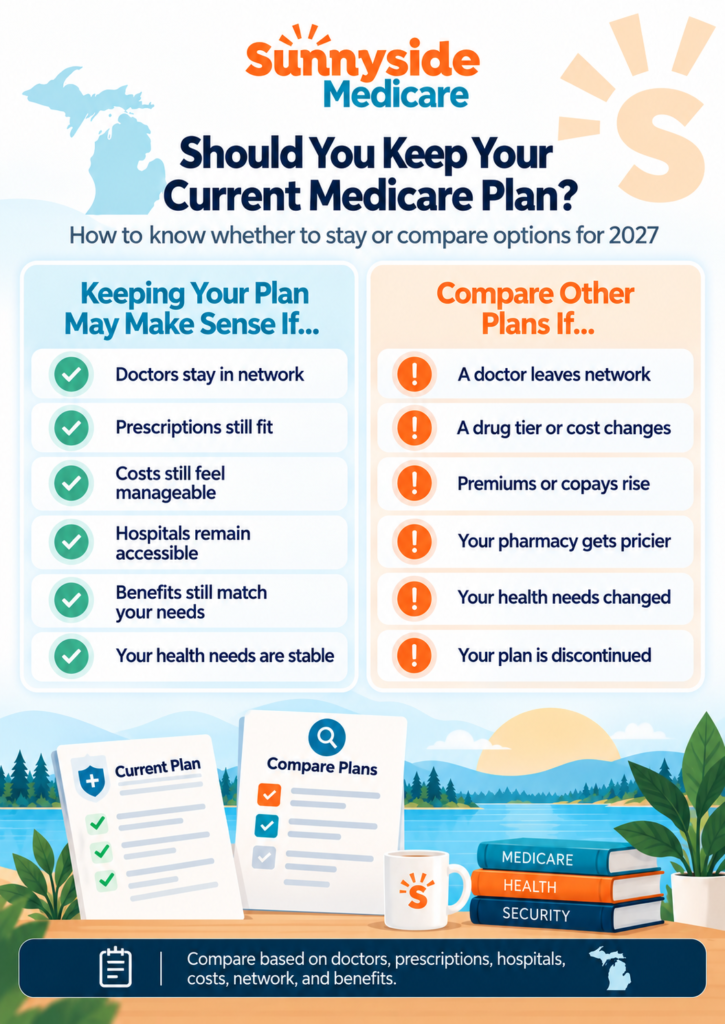
Annual Enrollment Period does not mean you need to switch Medicare plans every year. It means you have an opportunity to review your existing coverage and make a change when another option better fits your situation.
Keeping Your Current Plan May Make Sense If:
- Your doctors and specialists remain in network.
- Your preferred hospitals remain accessible.
- Your prescriptions remain covered affordably.
- Your pharmacy continues to work well.
- Premiums, copays, and coinsurance fit your budget.
- Your maximum out-of-pocket amount is acceptable.
- The benefits you actually use remain useful.
- Your healthcare needs have not materially changed.
Consider Comparing Other Plans If:
- Your doctor leaves the provider network.
- Your hospital is no longer in network.
- A prescription is removed from the formulary.
- A drug moves to a more expensive tier.
- Your premium or specialist copays increase significantly.
- Your preferred pharmacy becomes more expensive.
- You start new medications or expect a new treatment.
- Your travel or provider-access needs change.
- Your current plan is being discontinued.
Comparing Medicare plans does not obligate you to switch. Sometimes the result of a good comparison is confirming that your existing plan is still the right choice.
What Should You Do During Medicare AEP 2026?
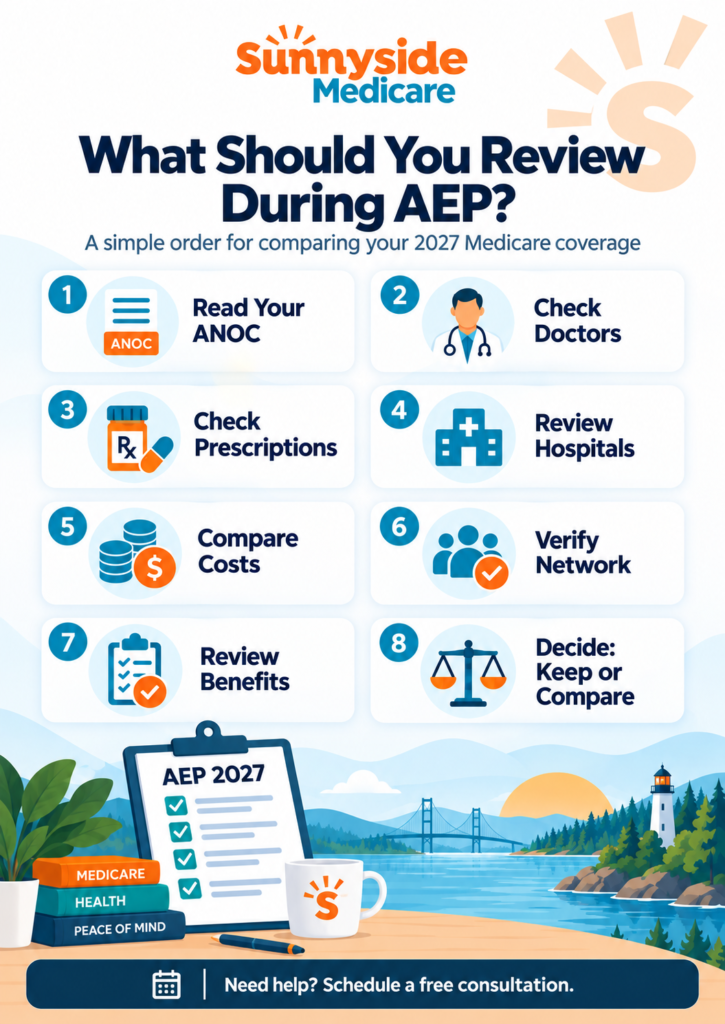
AEP gets easier when you review your coverage in a consistent order.
1. Read Your Annual Notice of Change
Start with the coverage you already have and identify what is actually changing for 2027.
2. Make a List of Your Doctors and Specialists
Prioritize the healthcare providers you want to keep.
3. List Your Preferred Hospitals
Include any hospital systems or facilities that matter for ongoing treatment.
4. Make a Current Prescription List
Include the exact medication, dosage, quantity, and frequency.
5. Check Your Pharmacy
Compare your current pharmacy with preferred pharmacies available under each plan.
6. Compare Total Costs
Do not evaluate Medicare coverage based on monthly premium alone. Consider premiums, deductibles, copays, coinsurance, prescription costs, and maximum out-of-pocket limits. Our Medicare Costs & Out-of-Pocket Guide explains the major Medicare cost categories in more detail.
7. Verify Provider Networks
Check the individual Medicare Advantage plan, not merely the insurance company. One private insurance company can offer several different Medicare Advantage plans with different provider networks.
8. Review Supplemental Benefits
Dental, vision, hearing, fitness, transportation, and OTC benefits can be useful. They should generally come after the healthcare services you are most likely to use.
9. Decide Whether Keeping or Changing Coverage Makes Sense
There is nothing wrong with keeping your current plan when it still works. The goal is not to change plans. The goal is to make an informed decision.
10. Get Help If You Need It
You can compare Medicare plans yourself using Medicare’s official plan-comparison tools. Michigan residents can also seek Medicare counseling or speak with a licensed insurance agent.
Sunnyside Medicare offers a free consultation to help Michigan residents compare Medicare plans based on doctors, prescriptions, hospitals, costs, and individual healthcare needs.
Be Careful Before Dropping Prescription Drug Coverage
If you change coverage during AEP, make sure you understand what happens to your prescription drug coverage. Going 63 days or more without Medicare drug coverage or other creditable prescription drug coverage after your eligibility period can potentially result in a Part D late enrollment penalty.
Do not drop prescription coverage without understanding the consequences.
Be Careful When Switching From Medicare Advantage to Original Medicare
During Medicare Open Enrollment, you can switch from a Medicare Advantage plan back to Original Medicare. You may also need a separate Medicare Part D prescription drug plan.
Medicare Supplement Insurance, commonly called Medigap, follows different rules. Medicare Supplement Insurance is not part of AEP.
Outside certain protected enrollment situations, medical underwriting may apply when you apply for a Medigap plan. That means you should not assume you can leave Medicare Advantage and automatically get any Medigap plan you want afterward.
If Medicare Supplement coverage is part of your strategy, understand your eligibility before completing the change.
Medicare AEP 2026 Michigan FAQs
What Is Medicare AEP for Seniors?
Medicare AEP is the Annual Enrollment Period for people who already have Medicare. It runs from October 15 through December 7 each year and allows eligible Medicare beneficiaries to make certain changes to Medicare Advantage and Medicare Part D coverage for the following year.
When Is Medicare AEP 2026 in Michigan?
The 2026 Medicare Annual Enrollment Period runs from October 15 through December 7, 2026. Most changes take effect January 1, 2027.
What Are the Biggest Medicare Changes for 2027?
Major changes include a $700 Part D maximum standard deductible, a $2,400 Part D out-of-pocket threshold, negotiated prices for 15 additional high-cost prescription drugs, the end of the Part D Premium Stabilization Demonstration, annual Medicare Advantage and Part D plan changes, and Michigan’s planned statewide expansion of MI Coordinated Health.
Do I Have to Change Medicare Plans During AEP?
No. If your existing coverage still works for your doctors, prescriptions, hospitals, budget, and healthcare needs, staying with your current plan may make sense.
What Happens If I Do Nothing During Medicare AEP?
Many Medicare plans continue into the next year when the plan remains available and you remain eligible. But the plan’s coverage and costs may change. Review your Annual Notice of Change before deciding to do nothing.
Can My Medicare Advantage Doctor Network Change?
Yes. Provider networks can change. Confirm important doctors, specialists, and hospitals with the specific 2027 plan you are considering.
Can My Prescription Coverage Change for 2027?
Yes. Part D plans can change formularies, drug tiers, copays, prior authorization requirements, and pharmacy networks. Compare your actual prescription medications when reviewing coverage.
Can I Switch From Medicare Advantage to Original Medicare During AEP?
Yes. Annual Enrollment Period allows eligible beneficiaries to move from Medicare Advantage back to Original Medicare. You may also need separate Part D prescription drug coverage.
Can I Get a Medigap Plan During AEP?
AEP does not create a universal Medicare Supplement open enrollment right. Medigap has separate enrollment rules, and medical underwriting may apply in some situations. Check your eligibility before leaving existing coverage if Medicare Supplement insurance is part of your plan.
What Is the Highest-Rated Medicare Advantage Plan in Michigan?
There is no single Medicare Advantage plan that is automatically best for every Michigan resident. CMS Star Ratings can help evaluate plan quality, but the right plan still depends on where you live, your doctors, hospital preferences, prescriptions, pharmacy, expected healthcare use, and costs.
What Are Some Things Original Medicare Does Not Usually Cover?
Original Medicare does not generally cover routine dental care, routine eye exams for glasses, hearing aids, or most outpatient prescription drugs. Coverage rules have exceptions, so use our Medicare Basics Guide for a broader explanation of what Medicare covers.
Where Can I Get Help Comparing Medicare Plans in Michigan?
You can compare coverage using official Medicare resources, use Michigan Medicare counseling services, or work with a licensed Medicare insurance agent. Sunnyside Medicare helps Michigan residents compare coverage based on doctors, prescriptions, hospitals, pharmacies, expected costs, and healthcare priorities.
Get Help Reviewing Your Medicare Coverage for 2027
You do not need to switch Medicare plans simply because it is Annual Enrollment Period. You do need to know whether your current coverage still works for you.
Sunnyside Medicare can help you review doctors and specialists, prescription medications, hospitals, provider networks, pharmacies, Medicare Advantage plans, Medicare Part D plans, deductibles, out-of-pocket costs, supplemental benefits, and Medicare options available where you live in Michigan.
Our licensed Medicare agents explain your options in plain English and help you compare coverage based on your actual healthcare needs.
Schedule a free consultation to review your Medicare options for 2027 before the December 7 deadline.